
Optimus Patient Kendra Herber Competes at the IPSTA 500 in Mason, Ohio
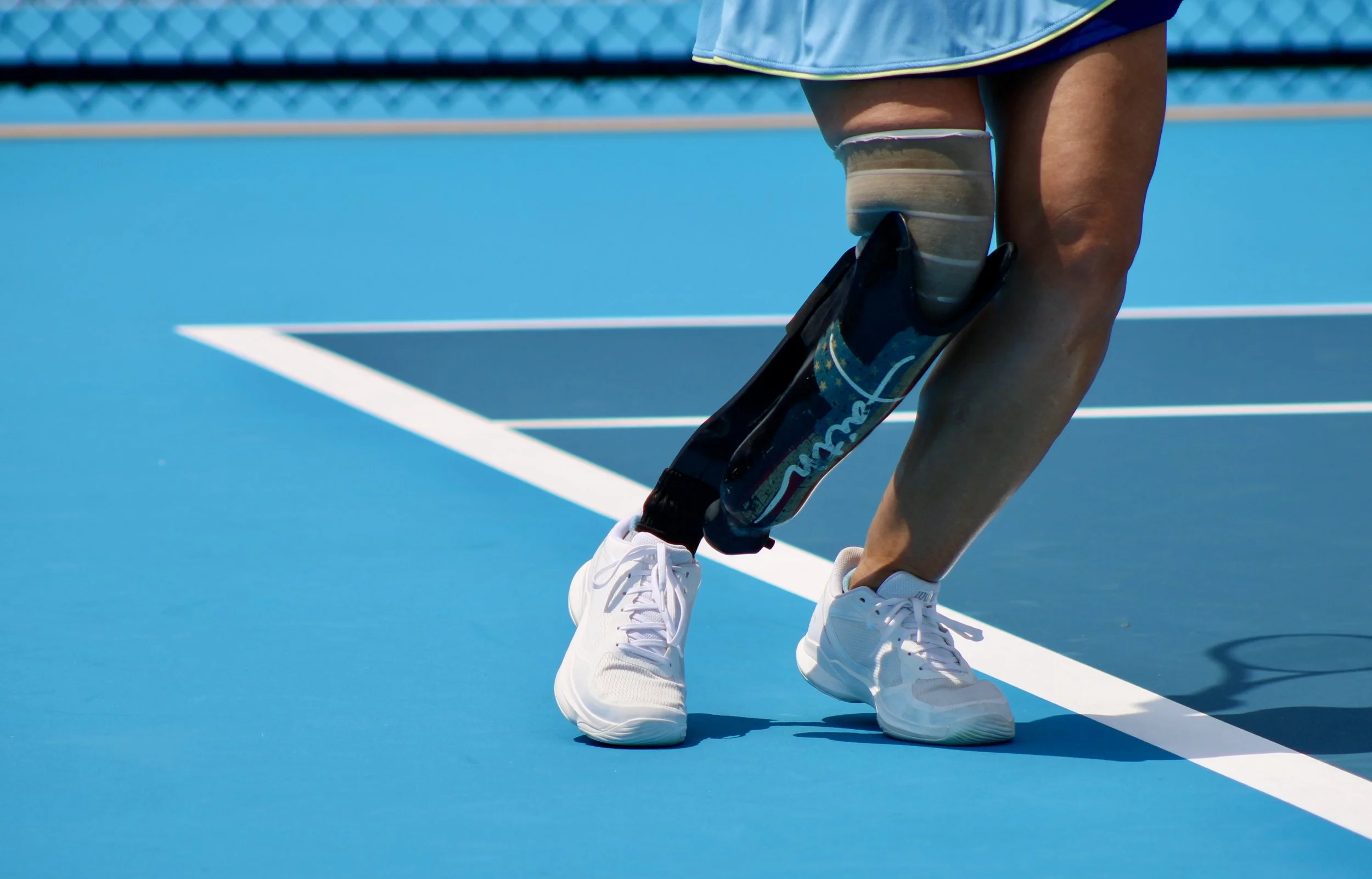
Kendra Herber spent the second week of August doing something most people would call impossible and she would call Tuesday: competing against the best Para Standing Tennis players on earth, in her own backyard.
The International Para Standing Tennis Association 500 ran August 8–10 at the Lindner Family Tennis Center in Mason, Ohio, immediately ahead of the Cincinnati Open. Kendra is the No. 1 ranked women's Para Standing Tennis player in the world. She lives in West Chester. She is also an Optimus Prosthetics patient, an English teacher at Lakota West High School, an author, a speaker, and a disability advocate.
"I don't want to be 'good for being disabled.' I want to be a good tennis player…period."
A tournament that came down to two points
Kendra fell in her opening singles match. In doubles, she and partner Sam Shnowske ran all the way to the championship, took the first set, dropped the second, and lost the deciding tiebreak 10–8.
Two points. Against a field that included several of the top-ranked players in the world.
Here is what she said afterward:
"I am really proud of my doubles performance in the championship match. I held my own against three of the best players in the world. As the only female, I feel like it helped make a statement about what us women are capable of.
I also think if you watched a video of my doubles match even six months ago, I would've looked like an entirely different player today. That just goes to show what focused hard work can do for your improvement.
Lastly, I am really excited to have two young new players compete at this tournament. One of them is a female who has a ton of potential in the sport. As we try to grow Para Standing Tennis, new juniors, especially females, are pivotal."
Read that middle paragraph again. Six months of focused work, visible on the court to anyone who knew what to look for.
And then read the last one. She had just come off a championship match decided by two points, and the thing she most wanted to talk about was the juniors coming up behind her.
What "the right team" actually means
Kendra has said before that she wanted to see what happens when someone with a big dream has a lot of people in her corner. We think that framing is exactly right, and we think it's worth being specific about what it involves, because "support" is a word that gets used a lot and explained almost never.
For an athlete competing at this level on a prosthesis, it involves:
Sockets built for lateral load. Tennis is not walking and it is not running in a straight line. It is a sport of hard cuts, split steps, and sudden direction changes. A socket that performs beautifully for daily activity can fail an athlete in the first game of a match.
Fit that survives a training block. Residual limb volume changes with training intensity, heat, and hydration. A fit dialed in during the off-season is not automatically the right fit in August.
Turnaround that matches a competition calendar. When a tournament is three weeks out, "we'll have it in six weeks" is not an answer. All Optimus fabrication is done in-house at our Dayton lab, which is why we can move at the speed an athlete's season actually requires.
Clinicians who show up. Our prosthetists attend physician appointments alongside patients and follow them into rehab settings. Continuity is not a marketing line here; it is how the work gets done.
None of that is unique to elite athletes. It is the same care model behind every patient we see — the difference is the goal at the end of it, not the standard of work.
Growing the sport in Southwest Ohio
Para Standing Tennis is still building its foundation in the United States, and Kendra's point about juniors is the whole ballgame. A sport grows when kids can see someone who looks like them competing at the highest level, close enough to home that it feels reachable.
Having an IPSTA 500 event at the Lindner Family Tennis Center matters for exactly that reason. So does having the world's top-ranked women's player living and teaching in Butler County.
If you or someone in your family is an amputee interested in adaptive sports, we are always glad to talk about what's possible — and to connect you with the athletes and organizations already doing it. That conversation costs nothing and it starts a lot of good things.
About Optimus Prosthetics
Optimus Prosthetics is a family-owned prosthetics practice serving amputees throughout Ohio, with offices in Dayton, Columbus, and Cincinnati. Our Cincinnati clinic is located at 2300 Wall Street, Suite F, and serves patients across Greater Cincinnati, including Mason, West Chester, Blue Ash, and Norwood.
We specialize in upper and lower limb prosthetics at every amputation level, mobility level, and age. Our prosthetists are ABC-certified and Ohio-licensed, with certification in osseointegration and physical therapy methods. We have physical therapists and physical therapist assistants on staff, and several members of our team are amputees themselves.
All fabrication is completed in-house, which allows for a quick turnaround on custom prosthetics. Consultations are free.
Cincinnati: (513) 918-2320 Dayton: (937) 454-1900 Columbus: (614) 263-5462
Congratulations on a hard-fought tournament, Kendra. On to the next one.